



A UNIQUELY CUSTOMIZABLE SYSTEM
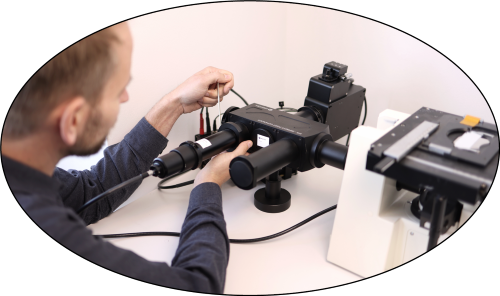
- Heavy-duty precision XYZ stage enables smooth lateral positioning and fine focus control
- Integrated 2-axis tilt mechanism allows the objective to be oriented at any angle relative to the specimen
- Modular mounts, posts, and adapters support both small samples and large or irregularly shaped specimens
- Designed to accommodate complex experimental setups with spatial constraints or auxiliary equipment

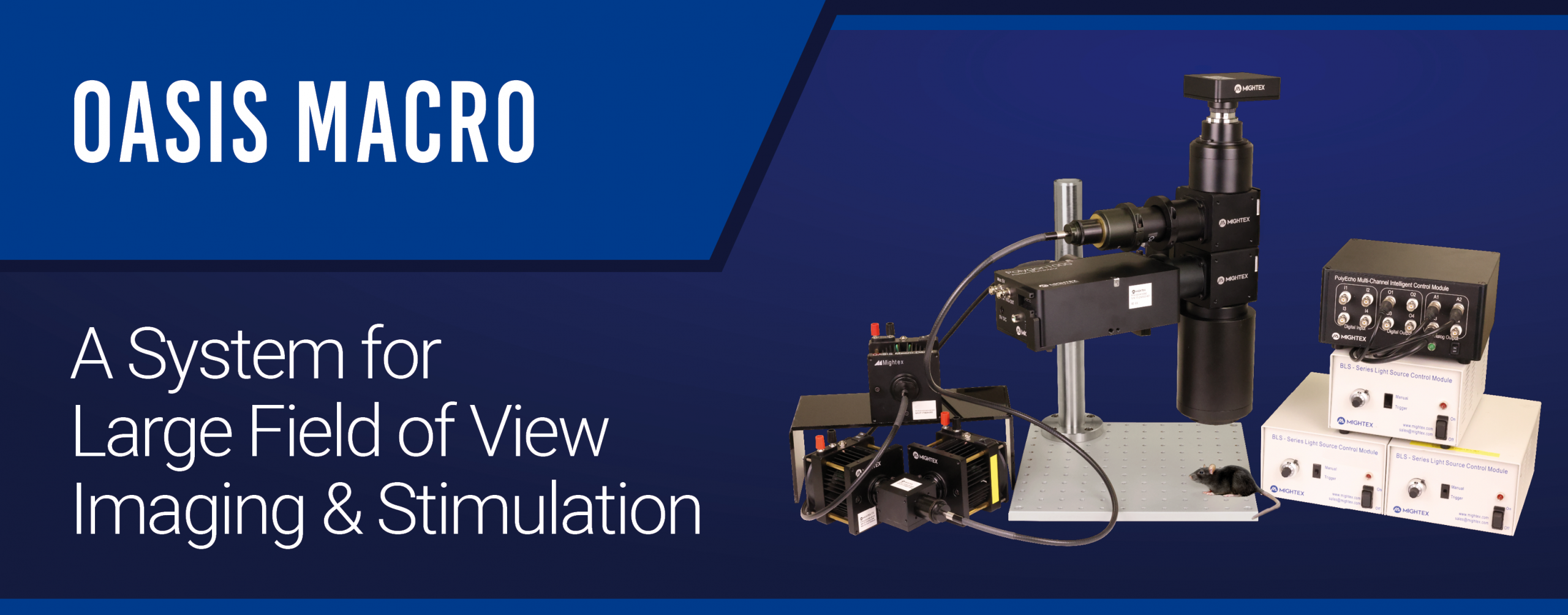
- Modular deck architecture allows easy scaling from a single deck to multi-deck configurations
- Expand and customize the optical path using standardized connecting plates and components
- Supports integration of additional imaging or photostimulation modules as experimental needs evolve
- Designed for long-term flexibility across diverse imaging and stimulation workflows, enabling rapid reconfiguration between applications without rebuilding the entire system
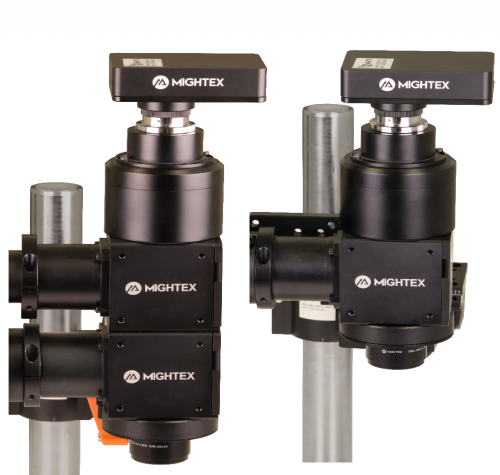
- Supports multiple excitation and emission filter sets for multi-colour imaging and photostimulation
- Magnetically seated filter cubes enable fast, tool-free swapping during experiments
- Easily reconfigure wavelength combinations to support different sensors or opsins
- Optimized optical design ensures high transmission and minimal signal loss

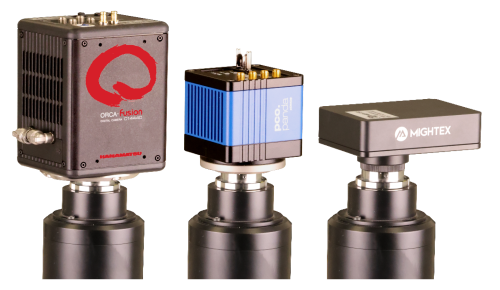
- Compatible with C-mount scientific cameras from Mightex and a wide range of third-party suppliers
- Optional beam-splitting adapter enables simultaneous use of two cameras
- Ideal for multi-modal imaging, dual-wavelength acquisition, or parallel recording setups
- Flexible camera integration allows researchers to leverage existing hardware investments
- Multiple illumination ports support integration of several light sources within a single system
- Seamless integration with Mightex’s Polygon1000 Pattern Illuminator for targeted photostimulation and widefield epifluorescence illumination
- Enables complex multi-colour and multi-modal illumination strategies
- Easily customize illumination configurations to match experimental requirements

- Compatible with macro objectives from Mightex and a variety of commercial objective suppliers
- Supports long working distance objectives up to 190 mm for flexible experimental geometry
- Enables large fields of view up to 10 mm × 10 mm without sacrificing resolution
- Interchangeable objectives allow rapid optimization for different specimens and applications

WHY CHOOSE OASIS MACRO?
Seamless Integration & Synchronization
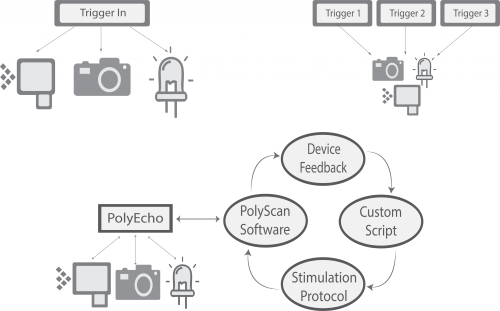
- Combine the OASIS Macro with the PolyEcho Intelligent I/O control module to support advanced synchronization requirements.
- Up to 12 digital inputs, 12 digital outputs, and 8 analog output channels for integration with multiple external systems.
- Enable multi-modal experiments through seamless synchronization of hardware and behavioural signals.
- Record behavioural trigger inputs directly in PolyScan software for precise timing and streamlined data analysis.
- Use incoming triggers for real-time pattern generation and targeted optogenetic stimulation via closed-loop control using PolyEcho and custom scripts.
Targeted Illumination with Polygon1000
- Designed for experiments requiring a large field of view with high optical power.
- Combines low-magnification, high-NA Macro objectives with the Mightex Polygon1000.
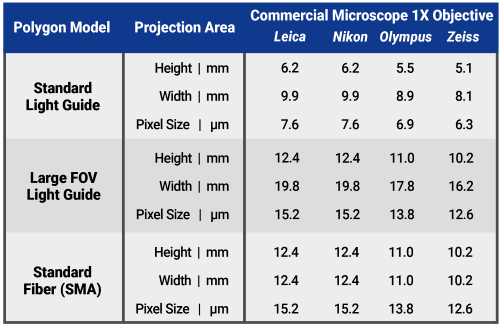
- Delivers high-intensity, targeted illumination across a field of view up to 10 mm × 10 mm.
- Achieves pixel resolution down to 3 µm for precise spatial control.
- Enables simultaneous targeted optogenetic stimulation across multiple cortical regions.
- Supports whole-cortex optogenetic activation using widefield illumination.
Flexible Imaging for Multiple Species and Modalities
- Interchangeable macro objective lenses offering wide field-of-view imaging at 1X, 2X, and 4X magnification.
- Suitable for head-fixed dynamic fluorescence imaging and larger animal models, including macaques and marmosets.
- Long working distance objectives allow easy integration into complex experimental setups with spatial constraints.
- Supports intrinsic imaging by integrating external Mightex Spotlight LEDs.
- Collect reflected light to record hemodynamic responses in the 550–625 nm range.
- Flexible XYZ stage with 2-axis tilt enables precise alignment at any angle.

INTUITIVE DATA COLLECTION PLATFORM
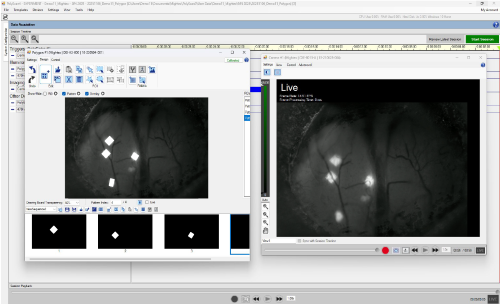
- Multi-panel display for rapid experimental overview
- Visualize multiple ROIs using the same camera window
- Real time background subtraction to enhance signal to noise to isolate fluorescence-specific signal fluctuations
- Overlaid timestamps of triggered events for quick visualization of evoked responses
- Quick access to LED settings for diverse applications, including intrinsic imaging
- Flexible real-time control of Polygon pattern generation for closed loop experiments
RECENT SUCCESS CASE
In order to conduct large FOV targeted optogenetics, Moravec and Williams used the OASIS Macro combined with the Polygon system to stimulate the peroneal nerve in small segments starting from the distal muscle insertion moving proximally towards the sciatic nerve in a rat expressing Channelrhodopsin-2 (ChR2) in the peroneal nerve after an intramuscular virus injection in the Tibialis Anterior (TA) muscle.

At the same time, they recorded muscle response to the optical stimulation in the TA muscle with intramuscular electromyography (EMG). This experiment characterized the strength of opsin expression and muscle responses along the length of the nerve at any given time point, which they found to be highly variable after virus injection. The OASIS Macro + Polygon system also allows spatial patterning of opsin expression along the nerve, both along its length as well as its width. This will serve to elucidate how opsin expression varies spatially in the nerve and how to activate specific muscle and nerve fibers.

Dr. Emma Moravec is a Biomedical Engineering PhD student in the Neural Engineering with a Doctorate of Philosophy, Interfacing, Modulation, and Optimization (NEIMO) Lab within the Joint Department of Biomedical Engineering at Marquette University and the Medical College of Wisconsin, under the supervision of Dr. Jordan Williams. Her research is conducted within the Neural Engineering & Modulation Laboratory, where she contributes to studies spanning neurophysiology and muscle physiology, optical and electrical stimulation, viral injection techniques, imaging, histology, and device fabrication. Her work supports ongoing investigations in neural prosthetics and viral gene therapy, with a focus on developing and applying advanced engineering tools to modulate and study neural systems.

Dr. Jordan J. Williams is an Assistant Professor in the Joint Department of Biomedical Engineering and Director of the Neural Engineering & Modulation Laboratory (NEMo Lab). He completed his postdoctoral training at the Systems Neuroscience Institute at the University of Pittsburgh and earned his M.D. from Washington University in St. Louis. His research focuses on peripheral optogenetics for motor stimulation, brain–machine interfaces and neural prosthetics, viral gene therapy approaches for spinal cord injury and disease, and the neural correlates of motor learning, with the goal of developing innovative technologies to restore and modulate motor function.

“The OASIS Macro combined with the Polygon system enabled us to perform large field-of-view, spatially precise optogenetic stimulation along the length of the peroneal nerve. By targeting small nerve segments while simultaneously recording intramuscular EMG, we were able to characterize variability in opsin expression and muscle response with a level of spatial control that would not have been possible with conventional approaches.”
— Dr. Emma Moravec, Biomedical Engineer at Marquette University
“What stood out with the OASIS Macro was its ability to deliver patterned, high-power illumination across a wide field while maintaining fine spatial resolution. This allowed us to map opsin expression both longitudinally and transversely along the nerve and selectively activate specific muscle and nerve fibers. The system has become a key tool for studying peripheral optogenetics and neuromuscular control.”
— Dr. Jordan J. Williams, Director of the Neural Engineering & Modulation Laboratory
SUPPORT & DEVELOPMENT
We provide comprehensive remote and in-person support throughout every stage of your experiment. From initial system installation and configuration to advanced experimental workflows, our technical and applications teams work closely with you to ensure reliable performance and smooth integration into your lab environment. Support is available for troubleshooting, optimization, and experimental planning, with responsive follow-ups to keep your research moving forward. Leveraging our global distributor network, we ensure consistent, high-quality support for users worldwide.
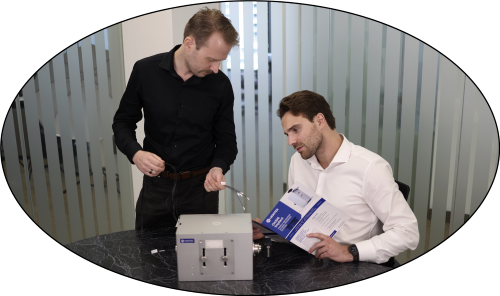
Our training programs are designed to help users quickly gain confidence and proficiency with both hardware and software. We offer detailed instruction on system setup, operation, and maintenance, as well as guidance on experimental workflows and best practices. For applications that require it, we also provide training on surgical procedures and preparation techniques relevant to optical imaging and optogenetics. Training can be delivered remotely or on-site, depending on your needs, and is tailored to the experience level and research goals of your team.

We maintain a robust online resource library to support your research beyond direct technical assistance. These resources include application notes, e-books, recorded webinars, tutorials, and references to relevant peer-reviewed publications. Designed to support both new and experienced users, our materials provide practical guidance, troubleshooting tips, and real-world examples to help you refine experimental design, improve data quality, and stay informed about emerging techniques.


We provide comprehensive remote and in-person support throughout every stage of your experiment. From initial system installation and configuration to advanced experimental workflows, our technical and applications teams work closely with you to ensure reliable performance and smooth integration into your lab environment. Support is available for troubleshooting, optimization, and experimental planning, with responsive follow-ups to keep your research moving forward. Leveraging our global distributor network, we ensure consistent, high-quality support for users worldwide.