



OVERVIEW
Since their development, optogenetic techniques have been essential for dissecting biological functions. Using photoresponsive constructs expressed via genetic engineering or viral infusion, researchers can perturb sub-cellular structures and pathways by applying specific wavelengths of light.
Primary application of these photoresponsive constructs, known as opsins, is in neuroscience for measuring and manipulating neuronal activity in vitro, ex vivo, or in vivo. However, these techniques are ubiquitous across many biological research fields including cell biology, microbiology, immunology, cardiology, and plant science. Optogenetic activation of cells can also be paired with techniques such as electrophysiology and dynamic fluorescence imaging.
Critical parameters for successful in vivo optogenetic experiments include: a light source with a compatible wavelength and sufficient power for the chosen opsin and cell population; fiber patch cords to provide illumination for opsin activation in freely-behaving animals; fiber implants with the correct specifications; precise temporal activation of the opsin; and behaviour cameras.
Mightex offers dedicated starter kits for in vivo optogenetics with all the components highlighted above to provide a cost-effective and easy to implement system for starting your optogenetics experiments. Explore below for more details on the different options.
OPTO KIT COMPONENTS
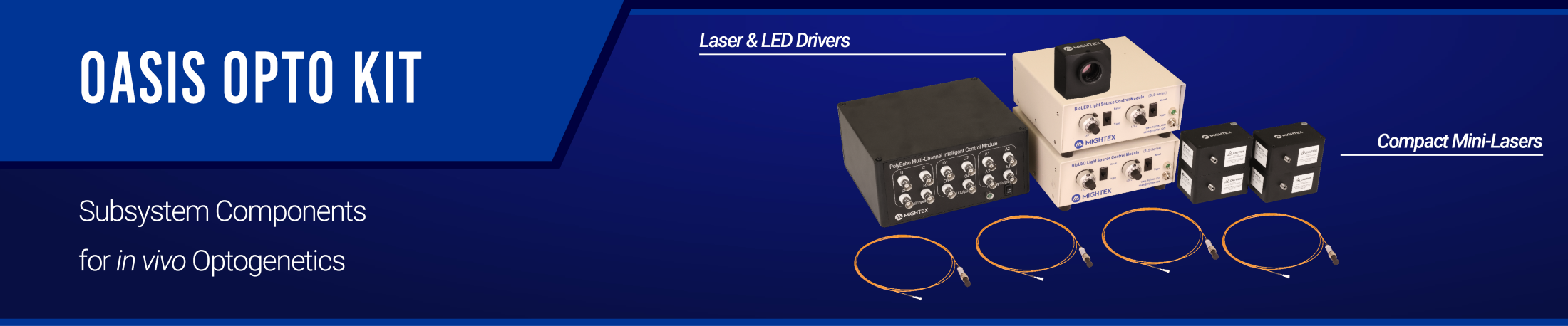
Compact Mini-Lasers
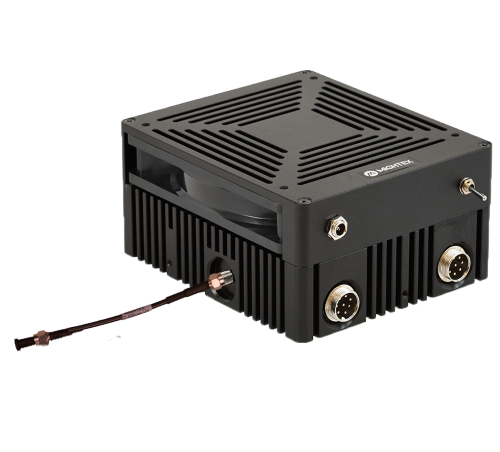
Fiber-coupled mini-laser module with SMA connection provides a powerful illumination source in a compact housing. Available with 450nm, 520nm, and 638nm peak wavelengths for opsins across the spectral range.
- Compact, machined metal housing with integrated heat sink
- 70-150 mW optical power from the tip of a fiber patch cord
- Locking electrical connector
- Laser Safety – Class 3B

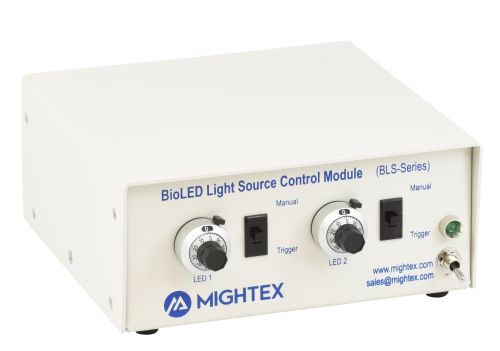
Laser Drivers
Compatible with our compact mini-lasers, these drivers can be triggered to provide precisely-timed and high-intensity light pulses in optogenetics experiments.
- Each driver can power up to two laser modules simultaneously
- Fine intensity control – 0.1% output intensity resolution enables precise optical power adjustment
- Fast timing precision – 20 μs time resolution supports accurate pulse and timing control
- External triggering – BNC trigger connector for reliable synchronization
Fiber Patch Cords
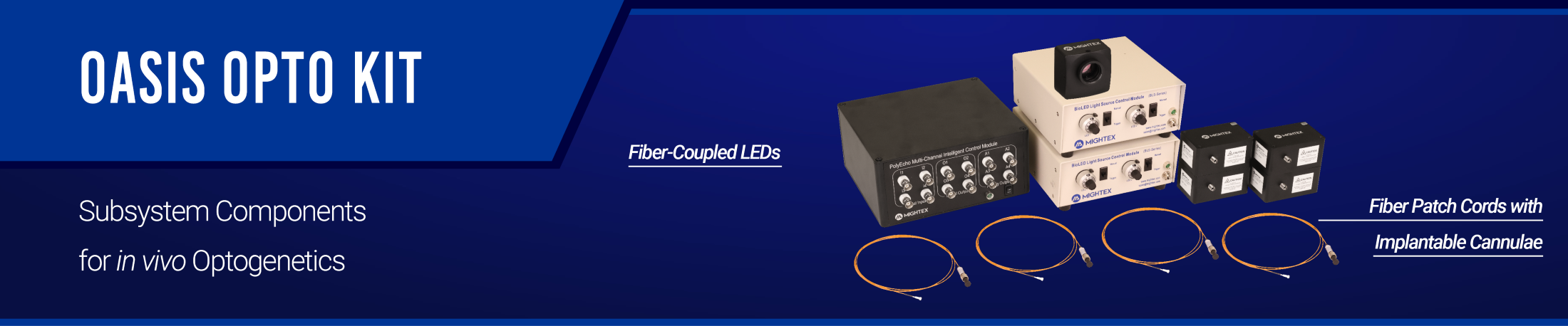
Flexible, durable, and lightweight patch cords with optimal transmission efficiency and a wide-range of configurations available. See our OASIS Accessories page for more details.
- Core diameter – 200um or 400um (0.39NA)
- Standard length – 1m to 5m (custom lengths available on request)
- Ferrule diameter – 1.25mm or 2.5mm
- Furcations – 1,2,4,7,or 19 branches
- We provide fiber options with rotary joints to allow a greater range of movement by the animal while preventing damage to the fiber

Implantable Fiber Cannulae
We offer implantable fiber cannulae and mating sleeves to couple with fiber patch cords for experiments in freely-behaving animals targeting deep brain regions, spinal regions, and more. Our fiber optic cannulae feature a ceramic ferrule with compatible mating sleeves and come in a wide-range of options to accommodate different experimental protocols and animal models. See our OASIS Accessories page for more details.
- Ferrule diameter – 1.25mm or 2.5mm
- Fiber core diameter – 200um or 400um
- Numerical aperture – 0.37NA or 0.50NA
- Protrusion length – 5mm or 10mm

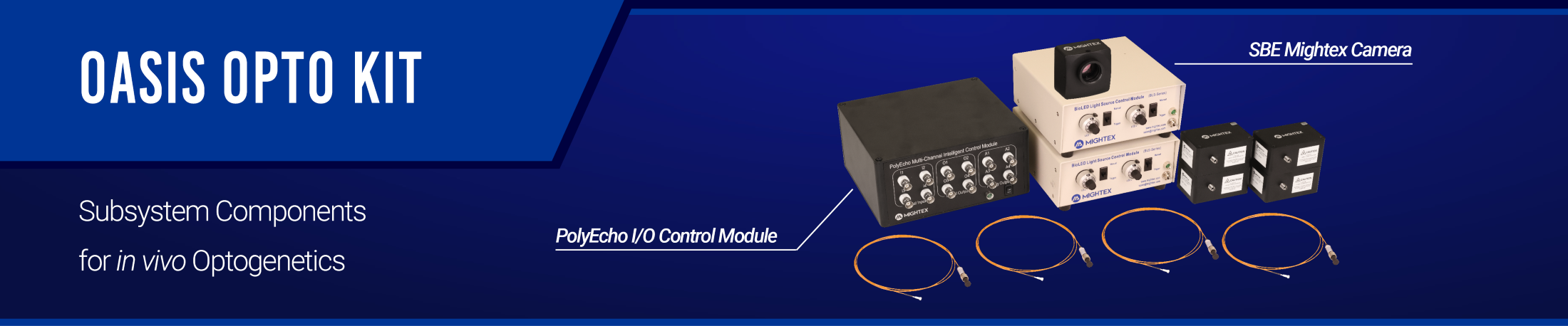
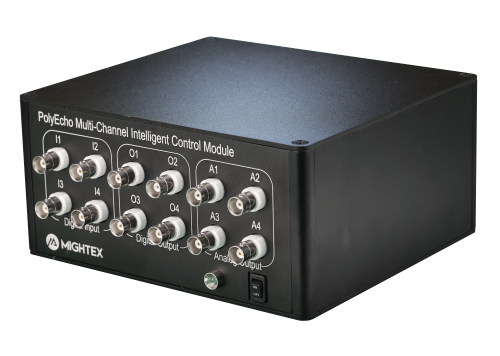
PolyEcho I/O Control Module
Precise synchronization across equipment including camera, light source, electrophysiology equipment, and more with user-defined or random trigger events ensuring reliable stimulation, data collection, and timestamping for downstream analysis.
- Record and export timestamps
- Multi-device synchronization
- Flexible and advanced triggering
- Channels operate independently or synchronized together
- Robust programmability in PolyScan
Behaviour Camera
Super-speed USB3.0 camera with a fast CMOS image sensor. IR-sensitive for lights-off behavioural recordings. Superior pixel resolution for reliable automated position/pose tracking. Excellent for behavioural data collection in parallel with optogenetic stimulation.
- Sensor type – Sony IMX273 global shutter
- Resolution – 1408 x 1088
- Frame rate – 250 fps (full resolution), up to 600+ fps using ROI mode
- Data transfer rate – 400 MB/s
- Built-in Processor – 128 frame on-board buffer

Fiber-Coupled LEDs
Mightex offers a large catalogue of LEDs for unique cases accommodating in vitro, ex vivo, and in vivo widefield optogenetic stimulation and covering a wide spectrum of wavelengths (UV/VIS/NIR). Explore our LED selection for microscopes, light-guide or fiber-coupled LEDs, and more here.
- High-power up to 10W optical output
- 45+ wavelengths from 235nm to 980nm
- Multiwavelength configurations
- Integrated lens and cooling
RECENT CALABORATION
“Working with the Mightex team has been a great experience—the camera shipped quickly, and technical support is highly responsive. We used the camera for pupil tracking during behavioural experiments. The camera has outstanding imaging quality and runs reliably with PolyScan software. It was also easy to integrate the system with open-source tools such as Bonsai, allowing us to flexibly update our experimental workflows.”

— Chang Xu, Graduate Student In the Creed Lab, Washington University in St. Louis
