




Huaming Wang is a postdoctoral researcher in the Zhang Lab at the Department of Pharmaceutical Sciences at the University of Pittsburgh’s School of Pharmacy, specializing in stimuli-responsive adhesive materials and light-controlled hydrogel systems. His research combines advanced polymer chemistry, rheological characterization, and precise UV photonics to investigate how dual-wavelength responsive hydrogels can achieve on-demand bonding and debonding for biomedical applications. Huaming’s work bridges materials science and biomedical engineering, with a focus on spatiotemporal control of smart adhesives using Mightex’s 365nm LED light source.
Dual‐Wavelength Responsive Hydrogel Glue Enabled by Precise Mightex Light Control
Research Summary
The development of stimuli‐responsive adhesives has attracted significant interest due to their potential applications in biomedical engineering, tissue repair, and soft robotics. In our recent study, we introduced a dual‐wavelength responsive hydrogel glue that uniquely combines visible‐light bonding with UV‐triggered debonding. Achieving such precise spatiotemporal control requires not only innovative material design, but also highly reliable photonic tools. Here, the Mightex 365 nm Type A light source played a pivotal role in enabling our research. This study was recently published in Advanced Science: https://doi.org/10.1002/advs.202507809.
To investigate the bonding and debonding processes, it was essential to apply UV light with high stability, uniformity, and repeatability. The Mightex system provided precise wavelength control and consistent irradiation, ensuring that the hydrogel glue underwent rapid and reproducible transitions. In particular, during rheological tests, the 365 nm source allowed us to quantify the viscoelastic changes of the hydrogel under dynamic light stimulation, thereby validating its reversible adhesion properties. Without the stable and tunable output of the Mightex device, such fine characterization would have been difficult to achieve. Figure 1(a)-(c) illustrates the rheological setup used in our experiments, highlighting the integration of the Mightex light source for real-time mechanical analysis. Mightex LED light sources can reach to 100 mW/cm2 through glass plate and stable maintain on this intensity. Adhesion failure test of two glass slides was performed on a universal tester (EZ-LX, Shimadzu Inc.) with Mightex light (365 nm), shown in Figure 1(d). Once Mightex light turned on, the two glass slides began to separate, displayed in Video 1, indicating the hydrogel network began to decompose under Mightex light (365 nm).
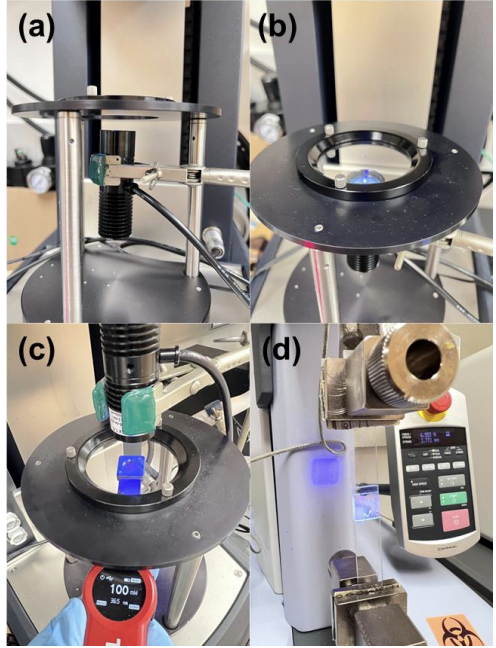
Figure 1 shows photos of Mightex’s Dual-mode universal LED controller (SLC-MA/CAxx-MU series) with a 365 nm LED light source used in our experiments. Figure 1(a)-(b) shows Mightex’s 365 nm LED setting on the rheometer to provide control light sources. Figure 1(c) displays Mightex’s LED transmitting through the glass plate. Figure 1(d) demonstrates the mechanical test of adhered glass cured by Mightex 365 nm LED sources.
Figure 2 presents the schematic design of the hydrogel system, where visible light induces covalent bonding while UV irradiation triggers on-demand debonding. Once irradiated by Mightex’s LED light (365 nm), the hydrogel network rapidly broke, leading to a significant decrease in adhesion and moduli. Together, these experiments demonstrate how Mightex’s illumination technology empowered us to discover a material with dual photonic responsiveness and controllable adhesion performance.

The left panel of Figure 2 is a schematic illustrating the dual wavelength hydrogel system. The right panel of Figure 2 shows the resulting adhesion test and rheology test of adhered glass under Mightex LED (365 nm) irradiation.
Looking forward, the synergy between advanced hydrogel chemistry and precise photonic tools opens pathways for next-generation biomedical adhesives. Applications such as minimally invasive surgery, wearable medical devices, and bioelectronics may all benefit from such dual-wavelength controllable bonding strategies. Our work highlights not only the promise of smart adhesive materials but also the indispensable role of Mightex’s optical systems in making these innovations possible.
Decomposition of the Hydrogel Network Under Mightex’s 365 nm LED