




Isaac V. Kauvar, PhD completed his doctoral research in Prof. Karl Deisseroth’s lab at Stanford University, co-advised by Prof. Gordon Wetzstein. He holds a B.S. in Engineering Physics, an M.S. in Electrical Engineering, and a PhD in Electrical Engineering, all from Stanford. His research combined cortex-wide calcium imaging with patterned optogenetic inhibition to study how activity across the mouse dorsal cortex drives behavior. His work used Mightex’s Polygon DMD pattern illuminator to inhibit multiple cortical regions at the same time in awake mice.
Publication Highlights
Targeted Optogenetic Stimulation of Motor and Non-Motor Cortices
Kauvar et al. used the Mightex Polygon to optogenetically inhibit the activity of multiple cortical regions—at the same time—in awake mice. They designed a calibration system to align the illumination to specific regions of cortex, and could synchronize illumination to different parts of a task the mouse was performing. This calibration system is demonstrated in these images. The Mightex system enabled them to target nearly the entirety of dorsal cortex. This causal manipulation was paired with another technique that we developed, COSMOS (see https://sites.google.com/view/getcosmos), which enables simultaneous recording of neural activity across the extent of mouse dorsal cortex. Using COSMOS, they found that there is activity throughout cortex related to the mouse’s task performance; using the Polygon, we could then show that inhibition of multiple cortical regions could disrupt task performance.
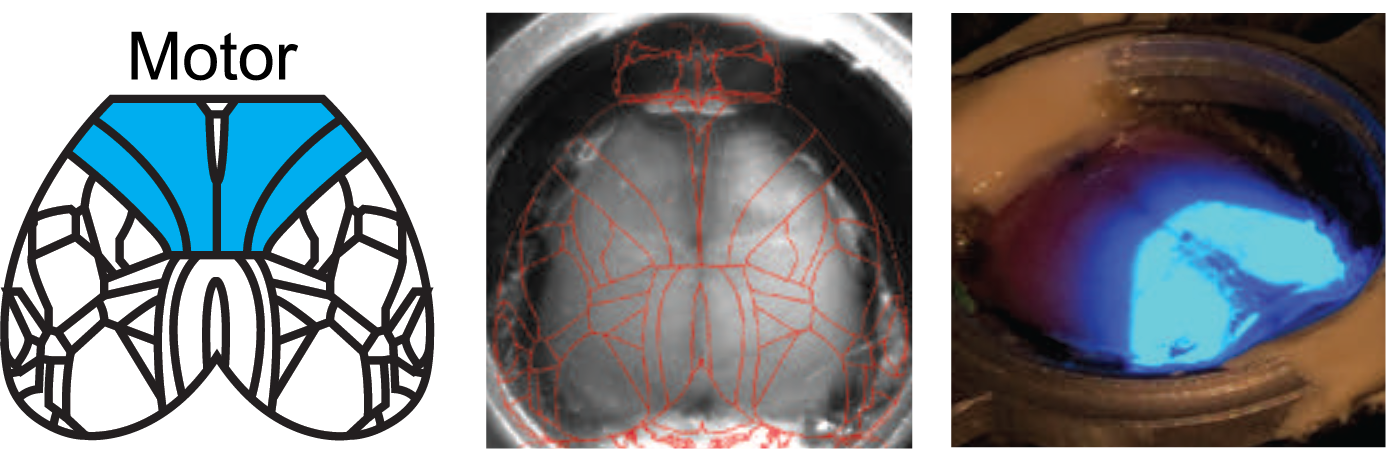
Figure 1. Calibration system used to align Mightex Polygon illumination patterns to specific regions of the mouse dorsal cortex.
The result: inhibiting multiple cortical regions at once disrupted the mouse’s task performance. This causal evidence supported the COSMOS finding that action-related information is encoded broadly across the cortex, rather than in a single dedicated region.
View publication
Cortex-Wide Optogenetics
This video shows our OASIS Macro and laser Polygon DMD illuminator being used to target ChR2 optogenetic stimulation (200um spots) across the cortex of an anesthetized mouse through a cranial window. This experiment was performed to elicit paw motor movements (Courtesy of University of Ottawa).
If the video doesn’t load, watch it on Vimeo.
Video 1. Cortex-wide ChR2 optogenetic stimulation with the Mightex OASIS Macro and Polygon DMD illuminator.
Together, these findings show the value of pairing large-scale recording with large-scale manipulation. COSMOS revealed where task-related activity lives across the cortex, and the Mightex Polygon made it possible to test that activity directly — by precisely inhibiting multiple, user-defined cortical regions at the same time, synchronized to behavior.
To learn more about using the Polygon for your own cortex-wide optogenetics research, get in touch today!