
Fiberscope vs. Miniscope: Choosing the Right Tool
for Advanced In Vivo Calcium Imaging
for Advanced In Vivo Calcium Imaging



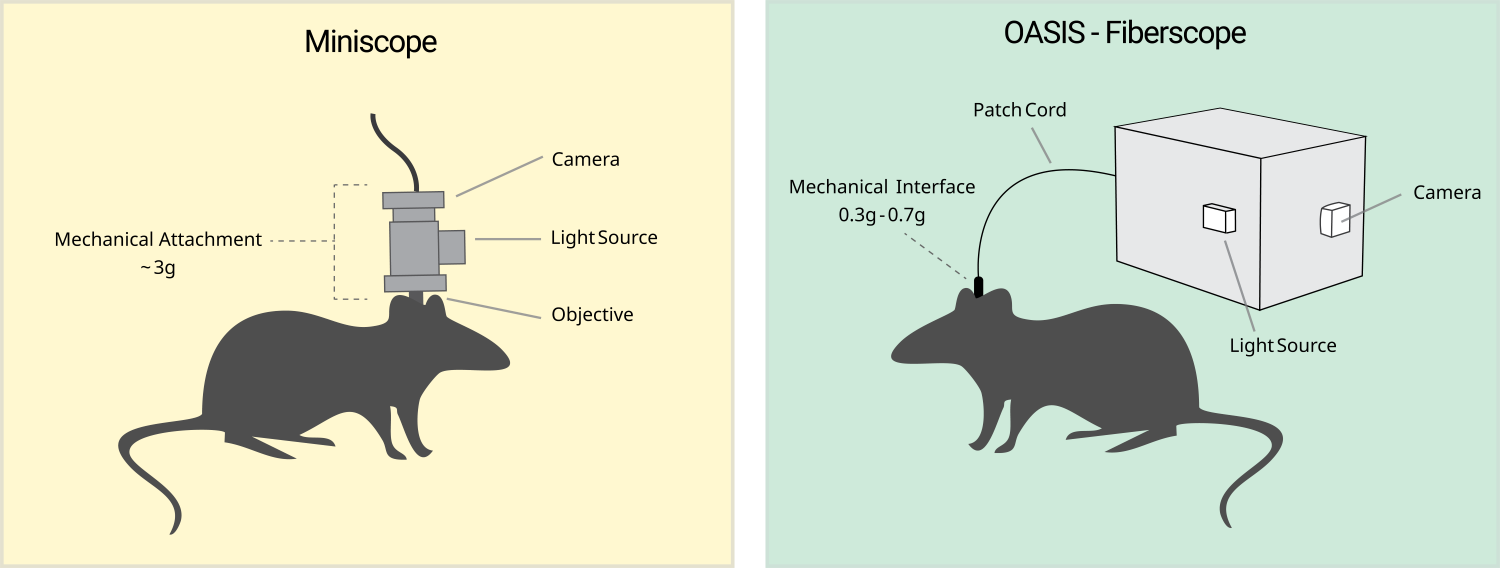
Miniature microscopes (miniscopes) and fiberscopes both enable cellular-resolution calcium imaging in freely behaving animals, allowing researchers to investigate neural activity during complex behaviours. While the two approaches share common elements, including genetically encoded calcium indicators, GRIN lens implants, fluorescence imaging, and downstream analysis workflows such as motion correction and cell segmentation, their fundamental approaches differ substantially. Miniscopes place much of the imaging hardware directly on the animal, providing a bulky and heavy solution for conventional calcium imaging experiments. Fiberscopes, such as the Mightex OASIS Fiberscope, instead transmit the image through a coherent fiber bundle to an external imaging platform, keeping the camera, illumination, and advanced optical hardware off the animal. This approach provides major advantages for researchers who require greater experimental flexibility, higher-performance imaging components, and the ability to expand their system as new experimental questions emerge.
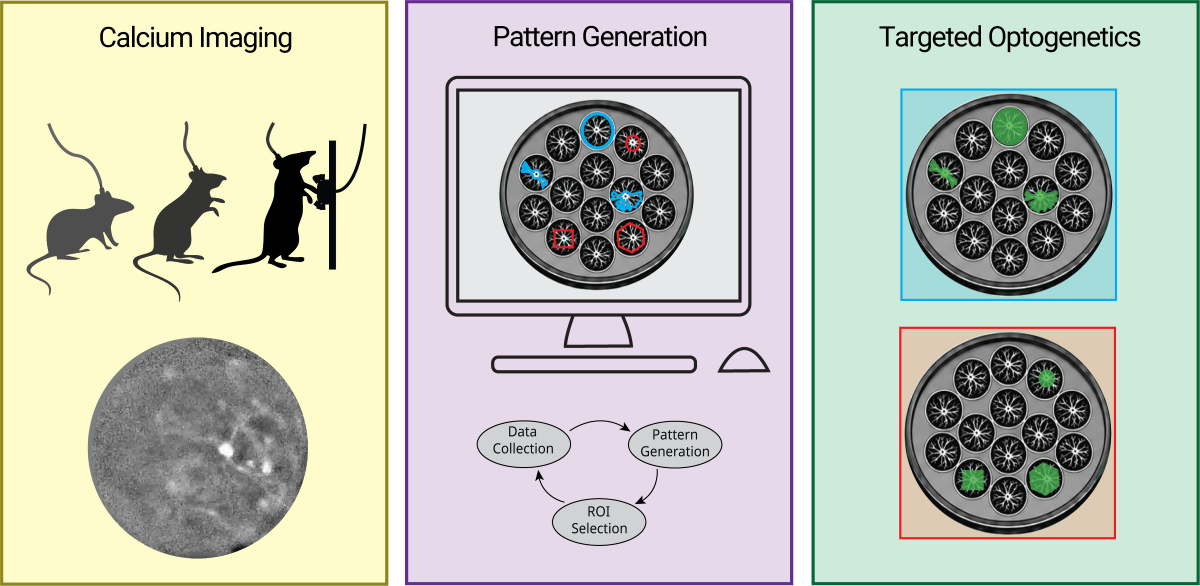
The benefits of the OASIS Fiberscope become particularly important for advanced multimodal experiments. The tabletop optical platform can be integrated with the Mightex Polygon DMD Illuminator, enabling spatially targeted optogenetic stimulation alongside cellular-resolution calcium imaging. Rather than illuminating an entire field of view, researchers can target defined cells or regions with precise patterns of light, opening the door to experiments that combine observation of neural activity with targeted manipulation of specific neuronal populations. Moverover, by combining real time in vivo calcium imaging with targeted optogenetics, the OASIS fiberscope provides a one-stop-shop for real-time closed-loop circuit dissection in freely behaving animals.. This makes the fiberscope particularly attractive for laboratories looking for a platform that can evolve alongside rapidly developing optical neuroscience techniques.
Fiberscopes also offer significant advantages when experimental scale and throughput become important. The OASIS Fiberscope can be configured for multi-site imaging, allowing researchers to investigate activity across multiple brain regions, as well as multi-animal recording for simultaneous experiments across several freely behaving animals. These capabilities can substantially increase experimental throughput while enabling more sophisticated studies of distributed neural circuits, behaviour, and social interaction. Miniscopes remain an effective option for laboratories focused primarily on established single-animal calcium imaging workflows, but a modular fiberscope platform provides considerably more room for experimental expansion. For researchers planning increasingly complex experiments, whether multi-region calcium imaging or targeted optogenetics and high-throughput multi-animal studies, the OASIS Fiberscope provides a flexible platform designed not only for today’s experiment, but for the next generation of in vivo neuroscience research.
| Feature | Fiberscope | Miniscope |
|---|---|---|
Camera & Illumination Hardware Kept Off-Animal | ✓ | X |
External Modular Optical Platform | ✓ | X |
Multicolour Recording | 3 Wavelengths | 2 Wavelengths |
Integration with High-Performance Scientific Cameras | ✓ | X |
Spatially Targeted Optogenetic Stimulation | ✓ | X |
All-Optical Closed-Loop Experiments | ✓ | X |
Simultaneous Multi-Region / Multi-Animal Imaging | ✓ | X |
Expandable Imaging & Photostimulation Hardware | ✓ | X |
Looking ahead, the modular OASIS fiberscope approach provides a compelling pathway toward high-speed in vivo voltage imaging, where detecting rapid and often subtle fluorescence changes places significantly greater demands on camera sensitivity, speed, and photon collection. Because the OASIS Fiberscope keeps the fluorescence detection away from the animal, it can be integrated with next-generation scientific cameras such as the Photometrics Kinetix, which combines a large field of view with high-speed acquisition and high-sensitivity detection suited to demanding voltage imaging applications. As genetically encoded voltage indicators continue to improve, pairing these emerging sensors with purpose-built, high-performance cameras and the flexible OASIS optical platform creates a pathway from conventional calcium imaging toward faster measurements of neuronal dynamics without requiring researchers to move to an entirely new experimental platform.
Learn more about the OASIS Fiberscope by exploring its features, or contact our customer support team for assistance.