
The significance of optogenetics and the tools driving the technology



Understanding how the brain and behaviour are connected is central to neuroscientific research. While historic techniques have allowed observation and manipulation of neuronal populations in many preparations, few techniques have advanced our understanding in the way that optogenetics has. Optogenetics has enabled researchers to control the activity of specific cells using light with physiologically relevant temporal resolution. By genetically introducing light-sensitive proteins, known as opsins, into targeted cell populations, researchers gained the ability to manipulate neural activity with unprecedented spatial and temporal precision2. This breakthrough transformed the study of neural circuits, allowing scientists to move beyond observing neuronal activity to directly investigating causal relationships between neural activity, behaviour, and brain function1.
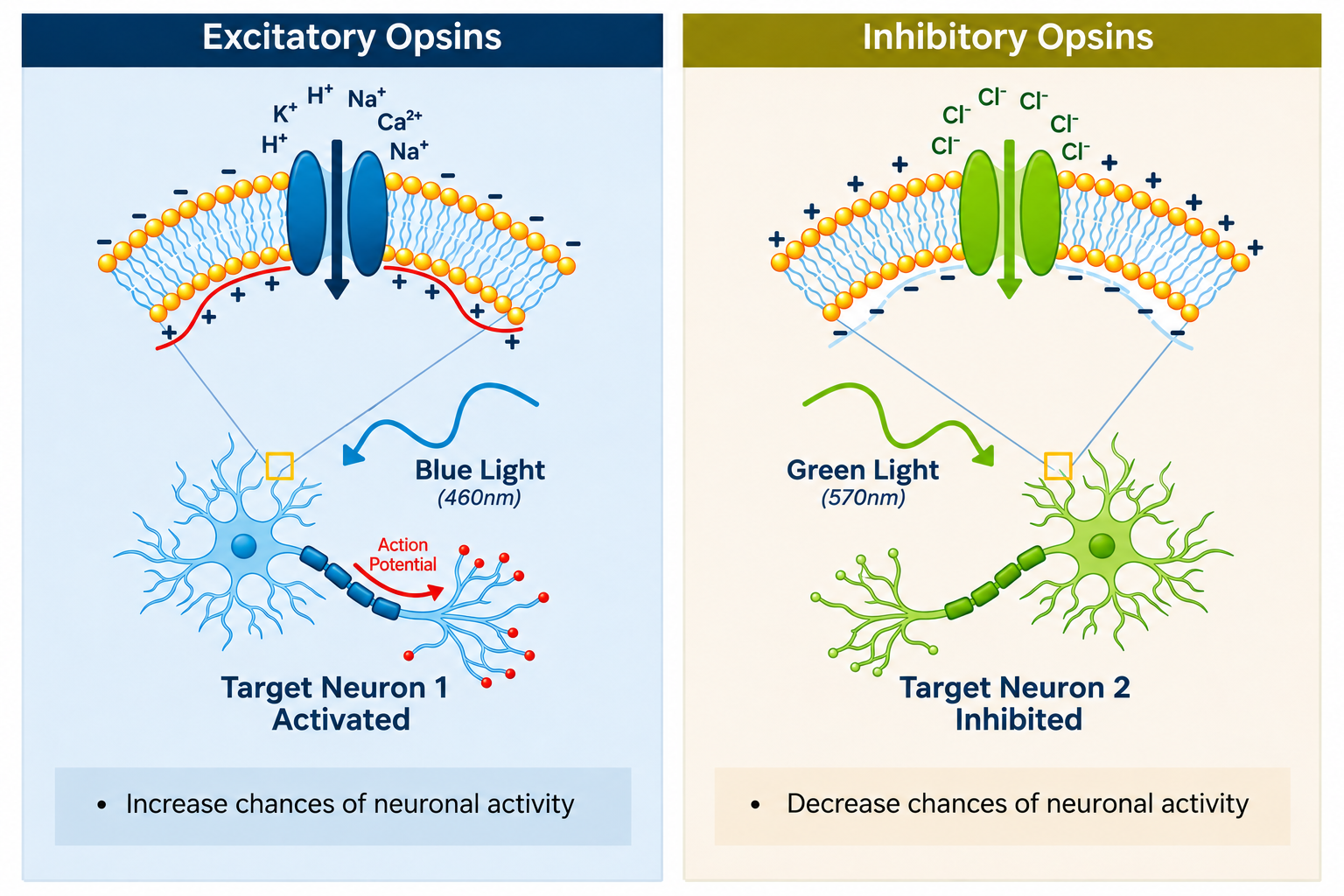
Figure 1: Overview of conceptual mechanism of action for excitatory and inhibitory opsins.
In October 2026, the transformative impact of optogenetics was formally recognized when Karl Deisseroth, Peter Hegemann, and Georg Nagel were awarded the Nobel Prize in Physiology or Medicine for their pioneering discoveries in light-gated ion channels and optogenetics3. This prestigious recognition highlights how optogenetics has fundamentally reshaped modern neuroscience, providing researchers with unprecedented capabilities to investigate neural circuits and uncover the mechanisms underlying brain function, behaviour, and neurological disorders3.
Over the past two decades, optogenetics has become an indispensable tool in neuroscience research, contributing to discoveries across learning, memory, sensory processing, movement, and neurological disorders1,2. Unlike traditional electrical stimulation, which can activate multiple cell types indiscriminately, optogenetics enables researchers to selectively excite or inhibit genetically defined populations of neurons1,2. The development of new opsins with different spectral sensitivities, activation kinetics, and functional properties has further expanded experimental possibilities2. Researchers can now investigate complex neural circuits using multiple wavelengths of light, combine optogenetic stimulation with calcium imaging or electrophysiology, and explore how specific patterns of neuronal activity influence behaviour and disease4.
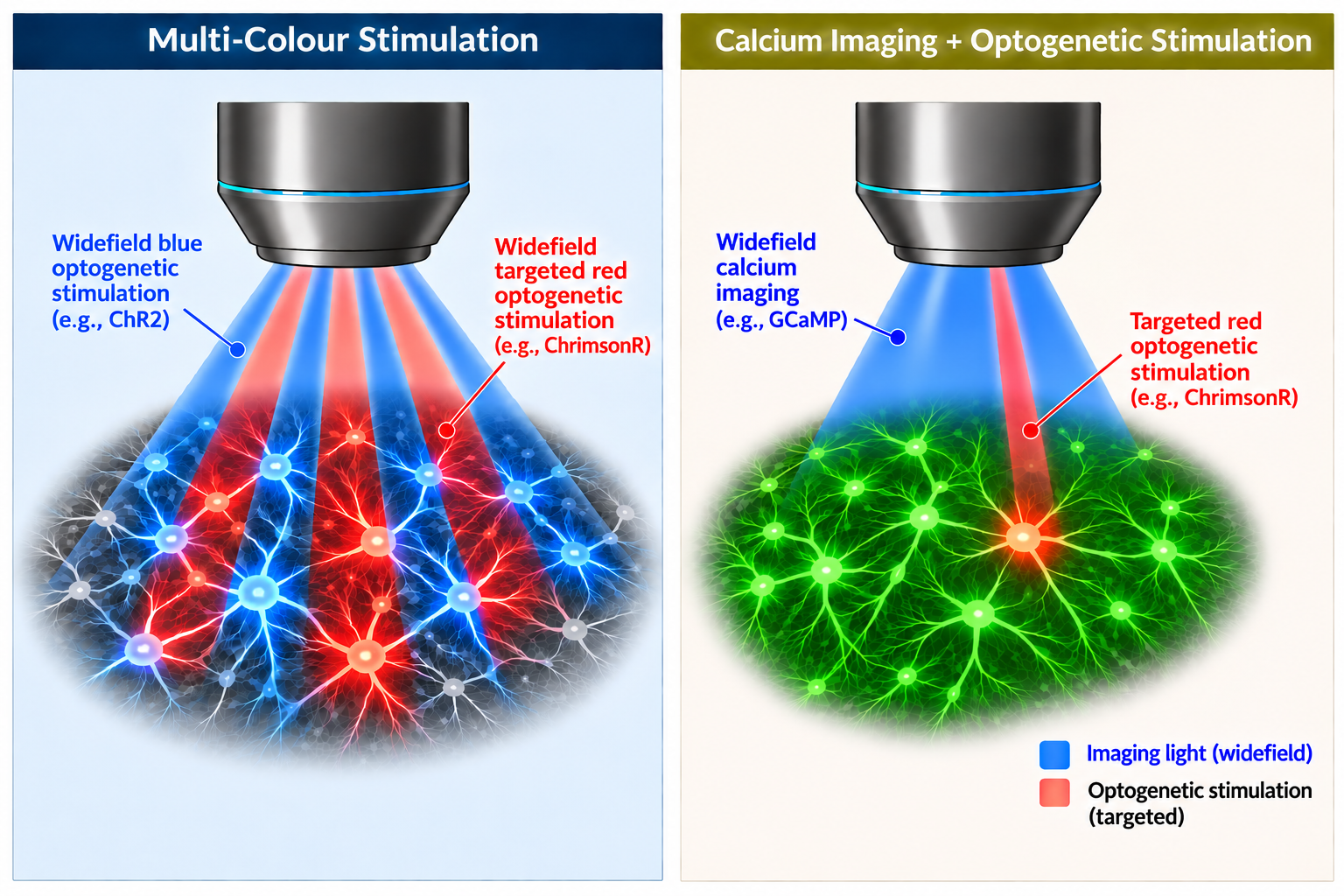
Figure 2: Example multiplexed optogenetics experimental approaches, including dual-colour targeted optogenetics and combined optogenetics and calcium imaging.
As optogenetic research has evolved, so too has the demand for increasingly sophisticated light-delivery technologies. Early experiments often relied on relatively simple illumination methods, such as LEDs or lasers coupled to optical fibers, to stimulate broad populations of neurons. While these approaches remain valuable, many modern experiments require greater spatial selectivity, flexible illumination patterns, and precise temporal control. Patterned illumination is particularly important for investigating heterogeneous neural populations, targeting individual cells or regions of interest (ROIs), and studying the functional organization of neural networks5. These capabilities are also extending the applications of optogenetics beyond neuroscience into cell biology, where light can be used to manipulate intracellular signalling, protein localization, and other cellular processes6.
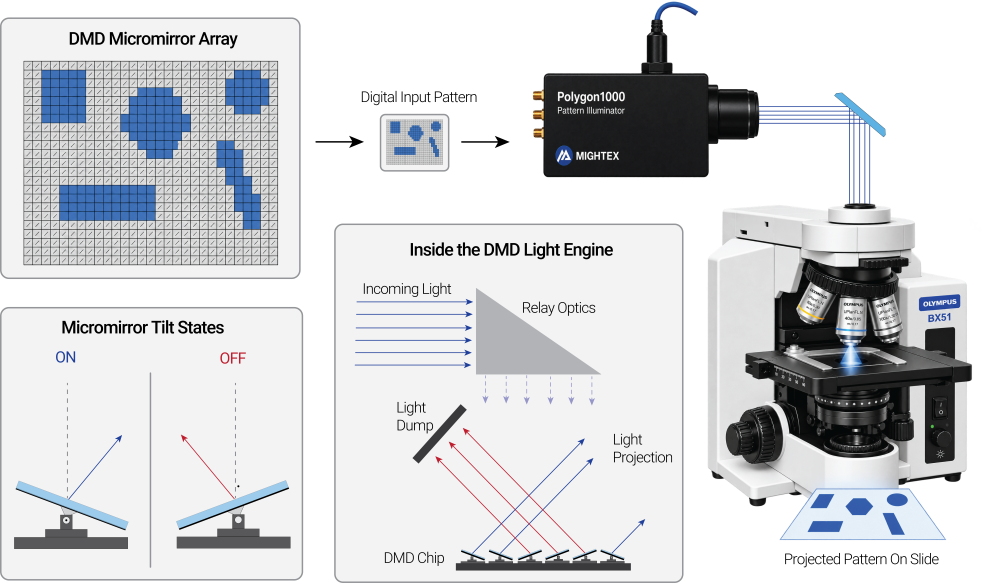
Figure 3: Diagram of DMD optics and Polygon microscope integration.
Advances in optical instrumentation have made increasingly precise and flexible optogenetic experiments possible. Modern systems incorporate high-power LEDs, lasers, optical fibers, and spatial light modulators to deliver controlled illumination across a range of experimental preparations. The Mightex Polygon series of patterned illuminators provides a versatile solution for spatially targeted optogenetics, using digital micromirror device (DMD) technology to project customizable illumination patterns onto selected cells or regions of interest. Unlike conventional widefield illumination, Polygon enables researchers to selectively illuminate multiple ROIs with independently defined spatial patterns, while supporting rapid switching and precise synchronization with imaging and other experimental equipment. Its compatibility with a variety of microscopy platforms and control options, including Mightex PolyScan software and third-party integrations, makes it suitable for diverse applications ranging from targeted neuronal activation to optogenetic manipulation of cellular signalling. As researchers continue to investigate increasingly complex biological systems, tools such as Mightex Polygon will play an important role in enabling more precise, adaptable, and sophisticated light-based experiments.