


Optogenetic Stimulation of 3D Neural Constructs with the Polygon
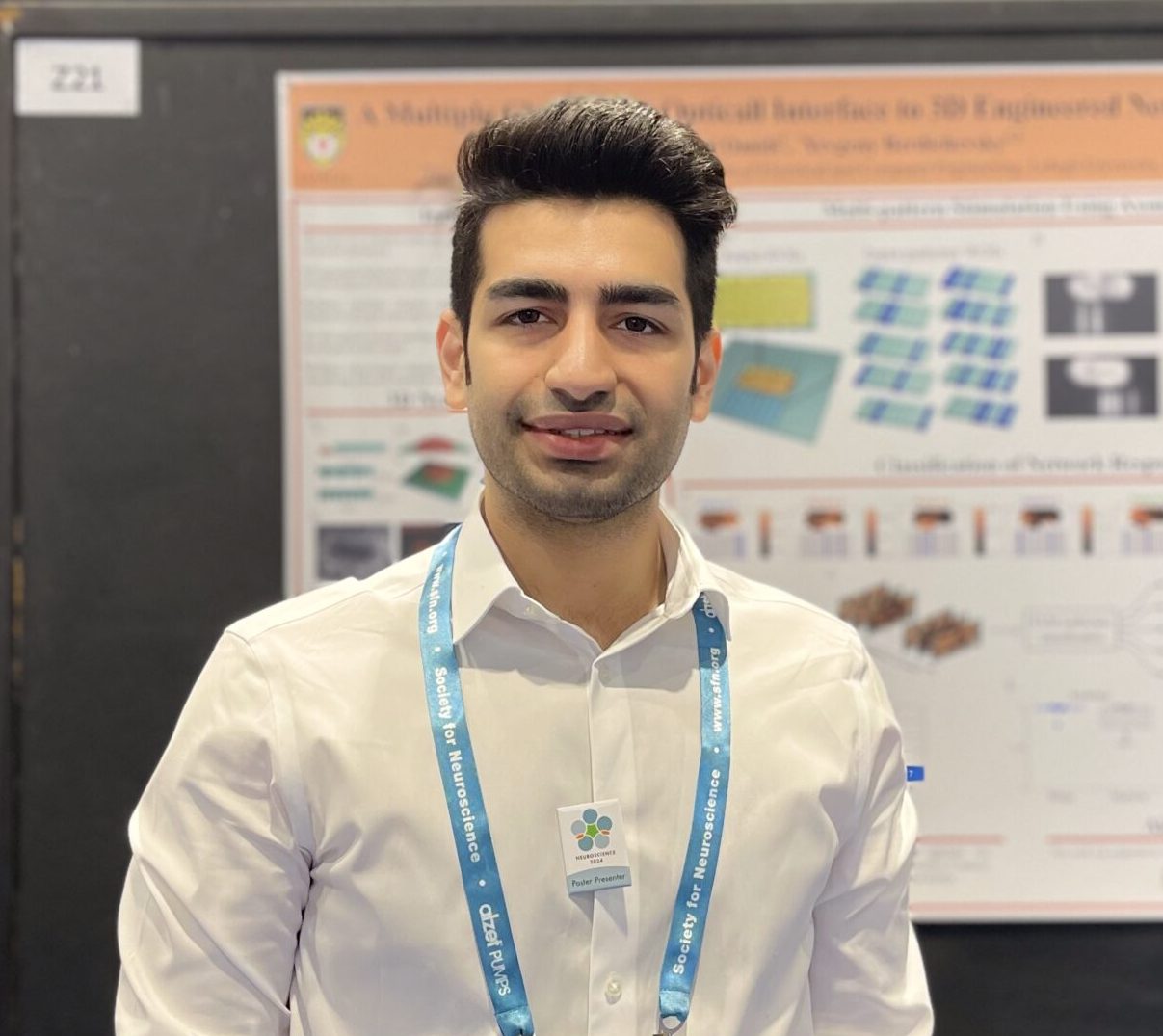
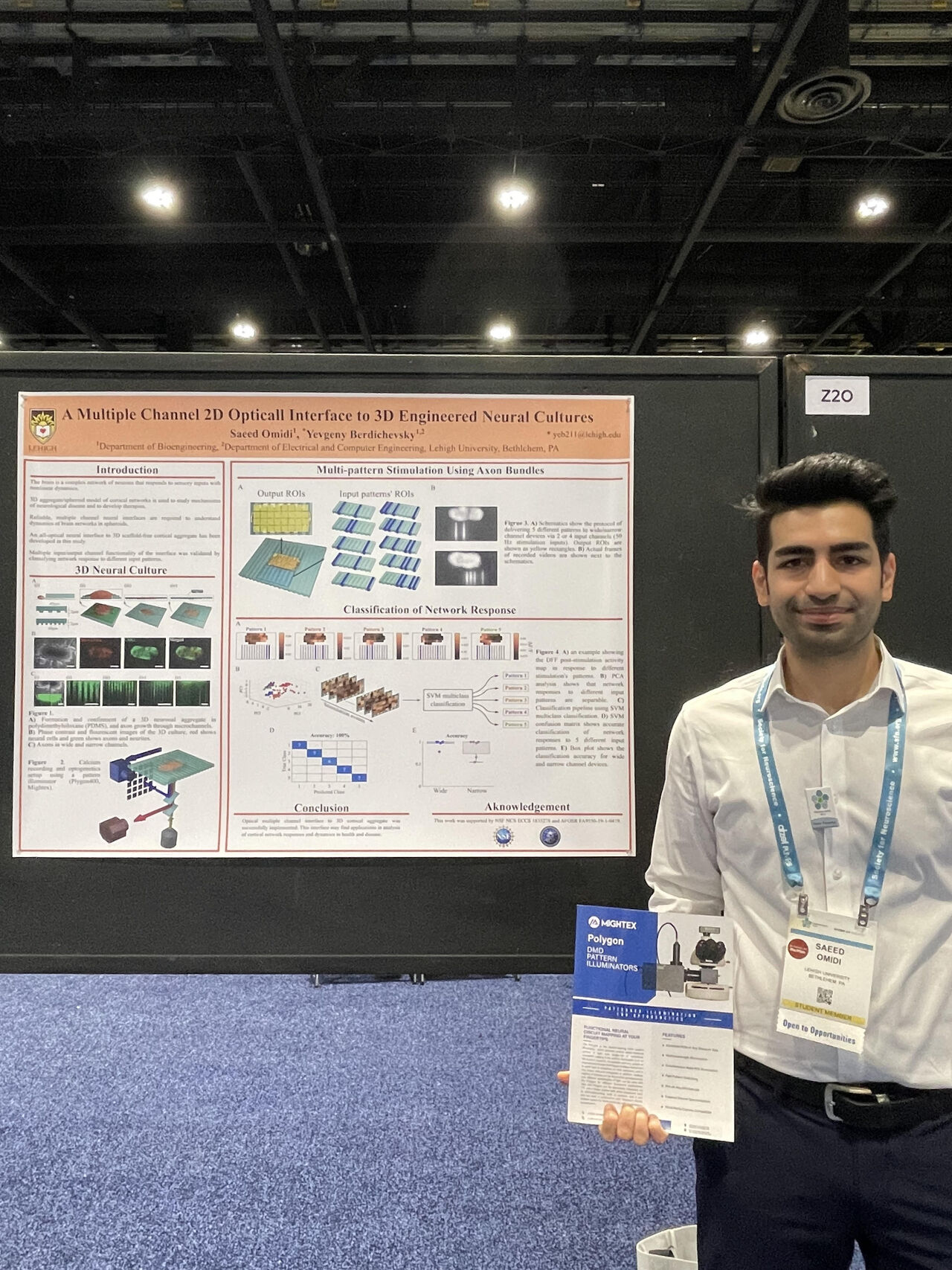
Saeed Omidi is a fourth-year Bioengineering Ph.D. student at Lehigh University, working with Prof. Yevgeny Berdichevsky, and specializing in neuroengineering and brain-on-chip systems. His research combines human neuron differentiation, optical neuromodulation, and machine learning to study brain information processing and neural network development. Saeed’s work bridges bioscience and engineering, with a focus on real-time analysis and control of complex neural systems. His work uses Mightex’s Polygon Pattern Illuminator and PolyScan software.
Research Highlights
All-Optical Interface to a 3D Neuronal Construct Mimicking Cortical Pathway Connectivity(4th Mightex Research Excellence Award, 2024)
Research Summary
This study developed an all-optical interface to stimulate and monitor three-dimensional neuronal constructs, mimicking how the brain receives sensory inputs. Saeed and his team guided axons and dendrites within the constructs into microchannel bundles and optogenetically stimulated them while recording activity through calcium imaging.
This stimulation created distinct input patterns, similar to real sensory signals, and the resulting neuronal responses showed characteristics of population coding. Notably, individual neurons displayed mixed selectivity, and the network could distinguish between different input patterns.
This approach avoids using costly microelectrode arrays and opens new possibilities for studying brain-like information processing and the impact of neurological disorders in vitro.
Mightex’s Contribution
Precise Optical Stimulation: The Mightex Polygon was used to deliver targeted blue light pulses to neurites inside specific micro-channels, enabling controlled optogenetic stimulation.
Custom Protocol Design: Our PolyScan software allowed Saeed and his team to select individual micro-channels and design precise stimulation protocols, simultaneously delivering pulse trains of varying wavelengths, pulse widths, and pulse intervals to specific ROIs, supporting complex experimental paradigms.
Integration with Analysis Tools: Mightex’s hardware and software enabled spatially-resolved activation of neuronal regions, which was visualized and quantified, facilitating downstream analysis such as machine learning-based classification of neural responses.
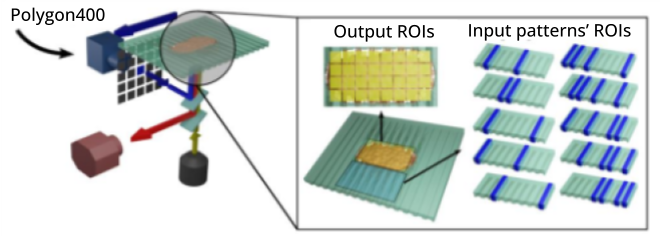
Together, Mightex’s hardware and software provided high spatial and temporal control of optical stimulation, critical for designing and analyzing complex optogenetic experiments.
A Multiple Channel 2D Optical Interface to 3D Engineered Neural Cultures(Mightex Travel Award, SfN 2024)
Studying neural circuits is essential for understanding disorders such as autism, epilepsy, and schizophrenia. The brain relies on feedforward sensory pathways and recurrent synaptic connections, but traditional 2D in-vitro models do not reproduce the 3D structure and connectivity found in vivo, and newer 3D in-vitro models generally lack sensory input connectivity.
To address this, Saeed and Prof. Yevgeny Berdichevsky built a 3D matrix-free “brain-on-a-dish” model with a compartmentalized 2D optical interface that mimics multi-channel sensory inputs. Axon bundles are confined in microchannels so that each one can be manipulated independently.
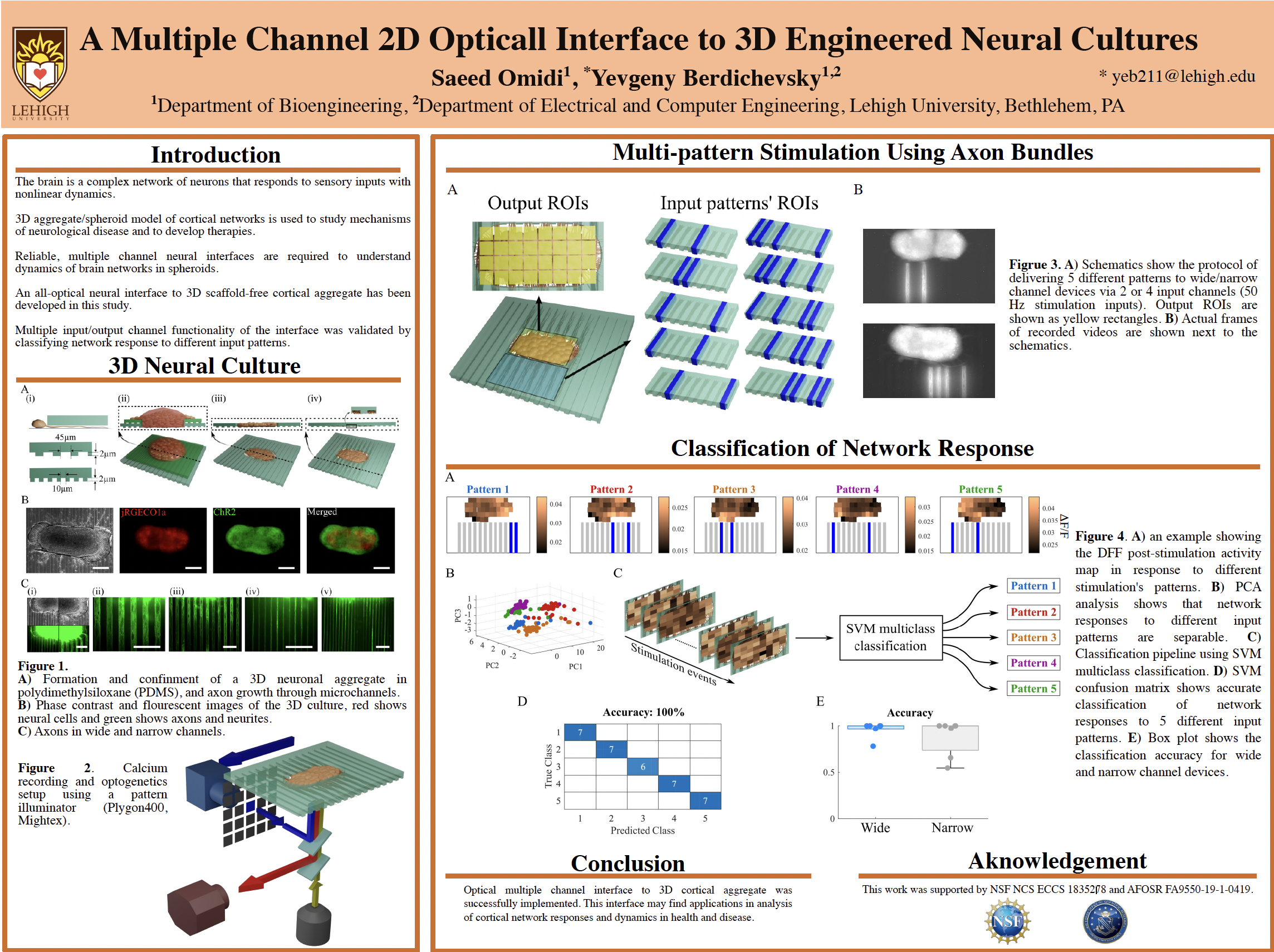
Primary rat cortical neurons expressing Channelrhodopsin2 (ChR2) and the calcium indicator jRGECO1a formed 3D aggregates and axonal bundles, and a Mightex Polygon patterned illuminator was used to stimulate each bundle independently. The 3D portion kept a dense, cortical-like structure with strong recurrent connectivity, and different input patterns produced network responses (jRGECO1a fluorescence changes) that were separable and classifiable, similar to responses evoked by sensory stimulation in primary sensory cortex.
This model combines sensory-like inputs with 3D in-vitro structure and may help explore the mechanisms of cortical disorders.